
Concrete Driveway Contractors in Maryland
Driveways Built to Outlast the Mortgage
Why Maryland Driveways Fail Early
Thin slabs
Bad base prep
No air entrainment
Joints cut late or in the wrong places
Our Concrete Driveway Services

New Concrete Driveway Installation
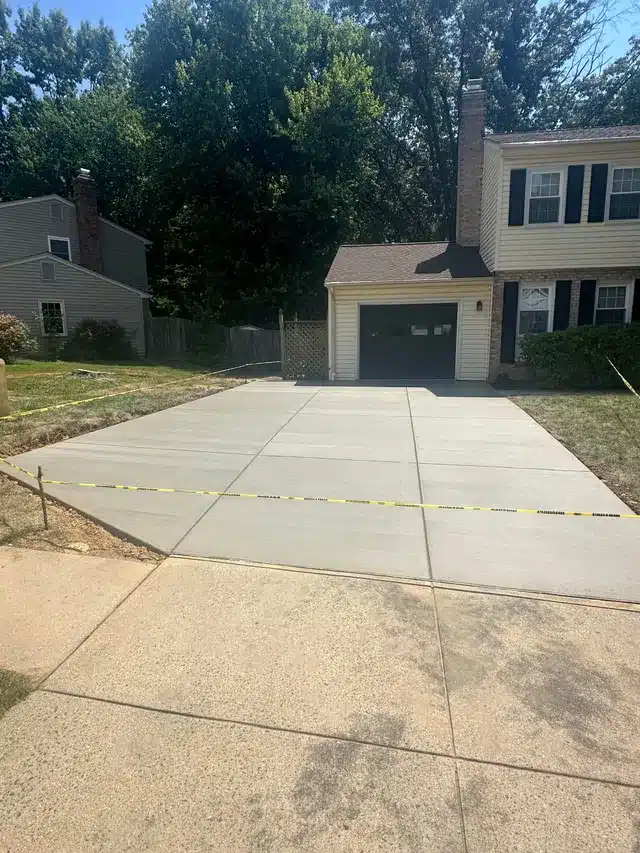
Driveway Replacement
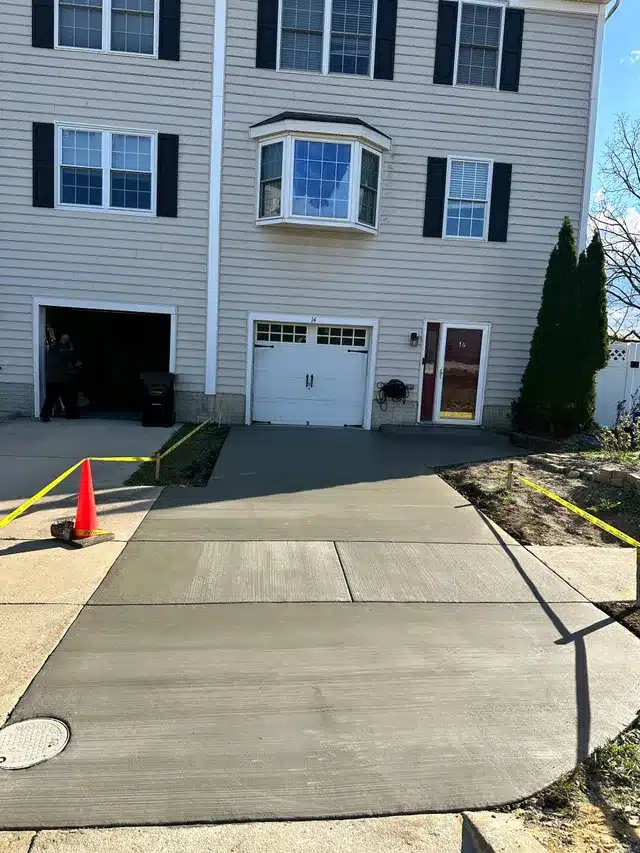
Concrete Driveway Repair

Stamped and Decorative Driveways

Parking Pads, Extensions and Turnarounds

Driveway Aprons and Street Transitions
How We Build a Driveway
1. Excavation
2. Stone base
3. Forming and grading
4. Reinforcement
5. Pour and finish
6. Jointing
7. Cure, seal and clean


Concrete vs. Asphalt vs. Pavers in Maryland
Asphalt costs less up front and more over time. It needs sealcoating every few years, softens in August heat and typically lasts 15 to 20 years here, against 30 or more for a properly built concrete driveway. Concrete also gives you finish and color options asphalt cannot.
Pavers look excellent on day one, but every one of them is an independent piece sitting on a sand bed. In Maryland clay and freeze-thaw cycling they settle unevenly, spread at the edges and grow weeds in the joints. Stamped concrete delivers a similar look as one solid surface. Read our full stamped concrete vs. pavers comparison.
For most Maryland homeowners planning to stay in the house, concrete is the lowest total cost of ownership. If you are selling in two years, that math changes, and we will say so.
What a New Concrete Driveway Costs
Square footage drives most of the price. A standard 4 inch residential slab costs less per square foot than a 5 or 6 inch slab built for trucks, RVs or trailers.
Soft clay, poor drainage or an old base that has washed out means more excavation and more stone. This is the part of the job you never see and the part that decides how long the driveway lasts.
Tearing out and hauling away an existing asphalt or concrete driveway is part of most replacements and is broken out as its own line on our proposal.
Tight access, steep grades and work in the county right of way add time. We handle the permit and the apron requirements so you are not chasing them.
Broom finish is the most economical. Stamped patterns, borders, color and exposed aggregate add cost and a lot of curb appeal.

How to Choose a Concrete Driveway Contractor Near You
A reliable concrete contractor will answer in specifics. Vagueness here is the biggest red flag there is.
If they have not looked at your soil, they cannot answer.
Ours is 162519. You can verify it with the Maryland Home Improvement Commission in about thirty seconds. Anyone doing home improvement work in Maryland is required to carry one.
The right answer is on schedule, at the correct spacing for the slab thickness. A contractor who shrugs at this question is leaving your slab to pick its own crack.
New concrete photographs beautifully. Ten-year-old concrete tells you the truth. Ask for addresses in your town and drive by.
A local crew can get to you for the estimate, show up on pour day when the weather window opens and come back if anything needs attention. We work out of Central Maryland and only take driveways within our service area.

Concrete Driveway FAQs
Properly built and maintained, 30 years or more. The ones failing at year eight almost always trace back to thin slabs, poor base or no air entrainment.
Foot traffic in 24 to 48 hours, cars at 7 days and full strength at 28 days. You get the schedule in writing. See how long concrete takes to cure for the details.
All concrete moves. We control where with reinforcement and properly placed joints, so movement lands in a cut line instead of across the middle of your slab.
Not the first winter. Deicing salts on new concrete cause surface scaling. After the first season, use calcium chloride sparingly and avoid ammonium-based products entirely. We go over this at handoff.
Replacing an existing driveway in kind often does not require one. New impervious surface, expansions and anything touching the county right of way usually do. We handle permitting as part of the job.
Spring and fall are ideal in Maryland because temperatures are moderate for curing. We pour through summer with early starts and proper curing, and we stop when overnight lows make a quality pour impossible.
Look for a Maryland MHIC license, a written itemized proposal, a clear answer on base depth, thickness and reinforcement, and driveways you can go look at in your own area. Local reviews on Google are a good second check.
Yes. Concrete patios, stamped concrete patios, steps, sidewalks and walkways, pool decks, basketball courts, slabs and pads, concrete repair and commercial concrete for local businesses.
Concrete Driveway Contractors Near You

Get Your Free Driveway Estimate
- 📞 Call or text 240-960-1928
- 📧 [email protected]
- 🕒 Monday to Friday, 7:00am to 5:00pm
- 🪪 MHIC #162519 | Licensed, Bonded & Insured